
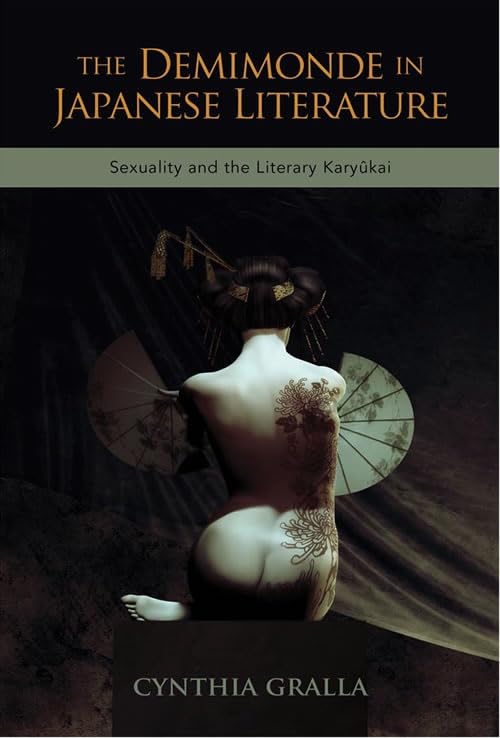
The Demimonde in Japanese Literature: Sexuality and the Literary Karyûkai Kindle Edition
Product details
| Management number | 221761280 | Release Date | 2026/05/03 | List Price | $16.00 | Model Number | 221761280 | ||
|---|---|---|---|---|---|---|---|---|---|
| Category | |||||||||
From the Edo-period works of Chikamatsu Monzaemon and Saikaku Iharu, to modern texts by Nagai Kafû, Tanizaki Junichiro, and Nobel-prize winner Kawabata Yasunari, the Japanese literary canon is filled with works about the demimonde, or karyûkai. After years of being closed off to Western influences on both its literature and social policy, Japan fully opened up to the West in the late nineteenth century and finally abolished legalized prostitution in 1956. Until then, the idea of a space set aside for sexuality, like Tokyo's Yoshiwara district, had been a powerful catalyst in structuring stories about the demimonde, and in fact, narratives about the demimonde have continued to flourish in Japan even in the second half of the 20th century and beyond, even though the actual physical space of the traditional karyûkai has disappeared. In breadth and accomplishment, Japan's demimonde literature rivals that of any other national literature; yet very little work analyzing the cultural, psychological, and textual significance of this space has been published to date. What is more, bringing comparative approaches to Japanese literary studies is a relatively new phenomenon, but Western literature is essential to understanding both the wider context in which demimonde literature blossomed, as well as to probing what is unique about Japan's karyûkai-themed texts. The Demimonde in Japanese Literature applies both a comparativist approach and psychoanalytic models to the examination of the literary karyûkai in a way that allows for a penetrating and multi-dimensional reading of its meaning in works produced during Japan's tumultuous twentieth century. This book analyzes representations of the demimonde in Japanese literature and other arts from the beginning of the twentieth century to the early 1990s, through fiction, critical essays, films, photographs, and performances by Nagai Kafû, Kôda Aya, Tanizaki Junichiro, Kuki Shûzô, Mishima Yukio, Hosoe Eikoh, Tamura Taijiro, Murakami Ryû, Ohno Kazuo, and Matsumoto Toshio. Throughout the book, the author views the demimonde in general and the karyûkai in particular through the changing paradigms of spatial terms and configurations in the twentieth-century Japanese imagination. In some narratives written during the pre-World War II period, for instance, the karyûkai is distanced from the reader by the connoisseur as a way of containing and idealizing it in 1930s Japan, in a climate of intense censorship and military imperialism; in others it is chronicled as disruptive to public space, its values and fetishes spreading into new physical spaces in the tumultuous interwar Tokyo metropole. During the postwar era, as the book's close readings show, the demimonde is often shown to transcend psychic space via the taboo movement of memory, and occasionally it is internalized in the text via a celebration of small spaces and a poetics of dwelling. Surveying such a variety of writings and artists allows for a thorough analysis of the representation of the space of the demimonde not just in literary texts, but in films, photographs, and dance/performance art as well. The study also draws on comparative examples from Western demimonde texts, especially those that were pivotal for Japanese writers and artists, and she uses them to formulate a complex argument about the socio-cultural, psychological, aesthetic, literary, and political significance of the space of the karyûkai. The book also helpfully includes translated passages from books that were not previously translated in their entirety into English, including Koda Aya's Nagareru. The Demimonde in Japanese Literature is an important book for all Asian studies, comparative literature, and women's studies collections. Read more
| XRay | Not Enabled |
|---|---|
| Language | English |
| File size | 448 KB |
| Page Flip | Enabled |
| Publisher | Cambria Press |
| Word Wise | Enabled |
| Print length | 336 pages |
| Accessibility | Learn more |
| Screen Reader | Supported |
| Publication date | December 28, 2010 |
| Enhanced typesetting | Enabled |
Bestseller ranking
Scrub Jackets




Customers who viewed this product also viewed
Japanese



Correction of product information
If you notice any omissions or errors in the product information on this page, please use the correction request form below.
Correction Request Form